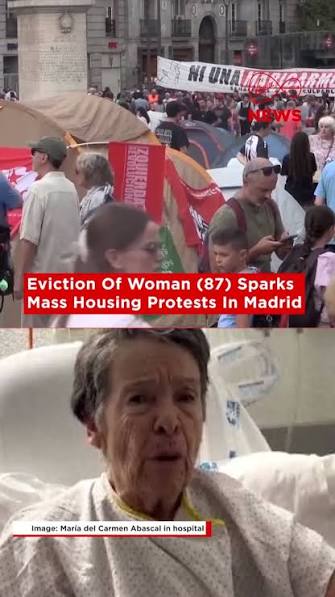
María del Carmen “Maricarmen” Abascal became the focus of Spain’s housing debate after she was forcibly evicted from the Madrid apartment where she had lived for about 71 years. The 87-year-old woman was removed from the property on September 23, 2026, after a long-running dispute over her tenancy and rent.
The eviction attracted widespread attention after images showed Abascal being taken from the building on a stretcher. Thousands of people subsequently protested in Madrid, turning her case into a highly visible example of the country’s wider arguments over housing affordability, tenant protection and evictions.
There has now been a major development. On September 29, Abascal accepted an agreement with the company that owns the apartment. Under the reported terms, she will return to the home after she is discharged from hospital, with a new eight-year rental contract and rent capped at 30% of her net income.
Latest Update: September 29, 2026
As of September 29, 2026, María del Carmen Abascal has accepted an agreement that will allow her to return to her Madrid apartment. Her lawyer, Beatriz Duro, confirmed the development after negotiations involving the property’s owner and representatives of the Madrid municipal housing system.
The agreement provides for an eight-year rental contract. Her rent will not exceed 30% of her net income, which is expected to put the monthly payment at roughly €500, according to Spanish reporting. The amount is close to what she had been paying before the dispute over the tenancy escalated.
Abascal is currently hospitalized following the eviction. Her lawyer said she has accepted the agreement and is expected to return to the apartment once doctors discharge her from the hospital.
The development came after several days of demonstrations in Madrid and other parts of Spain. The case has also coincided with new housing measures announced by Spain’s coalition government, although those broader measures still require parliamentary action before becoming law.
Who Is María del Carmen Abascal?
María del Carmen Abascal, widely known as Maricarmen, is an 87-year-old woman from Madrid’s Retiro neighborhood. Her connection to the apartment at the center of the dispute goes back to 1956, when her father first rented the property.
She was reportedly 17 when her family moved into the apartment. Under the old rental arrangement, the tenancy later passed within the family. After her mother died in 2005, Abascal became the tenant.
She remained in the property for decades, making the apartment her long-term family home. Her case became nationally known only after the eviction process reached its final stage in September 2026.
How Long Did María del Carmen Abascal Live in Her Home?
Abascal lived in the Madrid apartment for approximately 71 years. She moved there with her family in 1956 and remained there through several changes in the property and rental market.
The length of her tenancy became one of the defining details of the case. By the time she was evicted in September 2026, she had spent most of her life in the same home.
Her situation was also tied to an older form of regulated rental agreement. Spanish reporting says the tenancy had been inherited within the family, and the legal dispute ultimately centered on whether the long-standing arrangement could continue after changes in ownership and previous transfers of the contract.
Why Was María del Carmen Abascal Evicted?
The eviction followed a long-running legal dispute between Abascal and the company that owned the apartment. The property was acquired by Urbagestión in 2018, after which the relationship between the tenant and the new owner became increasingly difficult.
According to reporting from Spanish media, the company argued that the old rental arrangement could no longer continue under the same terms. Abascal’s legal representatives disputed the eviction and sought to keep her in the property.
Several previous attempts to remove her were postponed or rejected. According to reports, the legal battle continued for years before Spain’s Supreme Court ruled against Abascal in March 2026. The eventual eviction took place on September 23.
The case therefore was not a sudden eviction arising from a single missed payment. It followed years of legal disagreement over the tenancy, the ownership of the apartment and the terms under which Abascal could remain there.
How Much Was María del Carmen Abascal Paying in Rent?
Reports about the apartment’s rent show how sharply the financial dispute developed. Abascal had been paying around €500 per month in rent and associated costs under her previous arrangement.
After Urbagestión acquired the property, the amount demanded reportedly increased substantially. People reported that the rent was raised first to around €2,650 per month and later reduced to approximately €1,650.
Those figures were particularly significant because Abascal’s monthly pension was reported to be around €1,350 to €1,400. That meant the higher rental amounts exceeded or substantially consumed her monthly income.
The new agreement changes that calculation by tying her rent to her income. The payment will not exceed 30% of her net income for eight years.
What Happened During the Eviction?
The eviction was carried out on September 23, 2026. Images from the day showed Abascal being removed from the apartment on a stretcher and taken away in an ambulance.
She was given a limited amount of time to collect essential belongings before leaving. Her supporters gathered outside the building, and police were involved as authorities managed the crowd and carried out the court-ordered eviction.
The dramatic images quickly spread across social media and Spanish news outlets. The circumstances surrounding her removal helped transform what had been a long-running private legal dispute into a national conversation about housing and tenant protections.
Why Did Thousands Protest?
Abascal’s eviction became a rallying point for housing activists and people concerned about rising rents. Demonstrators gathered in Madrid’s Puerta del Sol, where a protest encampment remained in place for several days.
Reports said thousands of people participated in demonstrations in Madrid, while smaller protests were also reported in other Spanish cities. Protesters called for stronger protections for tenants and measures addressing situations where people face eviction without an affordable alternative home.
The protests were not solely about Abascal’s individual circumstances. Housing groups used her case to draw attention to wider problems involving rental prices, shortages of affordable housing and the treatment of long-term tenants.
Did the Madrid City Council Try to Help?
The Madrid municipal government became involved in the dispute. The Empresa Municipal de Vivienda y Suelo, or EMVS, later participated as a mediator in negotiations between Abascal’s representatives and Urbagestión.
Before the eventual agreement, Urbagestión proposed a possible solution involving social housing. Madrid City Council rejected that emergency proposal on September 25, saying the apartment did not meet the legal requirements for the suggested social housing program.
The later negotiations through the municipal housing system produced a different outcome. The EMVS helped mediate the agreement that now allows Abascal to return as a tenant under a new contract.
What Is the New Agreement?
The agreement gives Abascal a new eight-year rental contract for the apartment. Her rent will be limited to 30% of her net income, with Spanish reporting putting the expected amount at approximately €500 per month.
The arrangement means that Abascal can return to the apartment rather than move permanently into alternative accommodation. Her personal belongings reportedly remained in the property after the eviction.
Her lawyer said the agreement was reached after several hours of negotiations involving the property owner, Abascal’s family, her legal representatives and the municipal housing authority.
Is María del Carmen Abascal Returning Home?
Yes. As of September 29, 2026, Abascal has accepted the agreement and is expected to return to her apartment after leaving hospital. Her lawyer confirmed that the arrangement has been accepted, marking a significant change from the situation immediately after her September 23 eviction.
Abascal was hospitalized after the eviction and is receiving medical care. Reports say she will return home once she is discharged.
The return is therefore not immediate while she remains hospitalized. The agreement establishes the conditions for her return after her medical discharge.
Spain Housing Crisis and the Abascal Case
The controversy surrounding Abascal’s eviction has unfolded during a broader housing crisis in Spain. Housing costs have risen in many areas, while a shortage of homes has made it difficult for some residents to find affordable accommodation.
Madrid has been particularly affected by high housing costs. The city has also experienced strong demand for rental properties, creating tension between property owners, investment companies and tenants seeking long-term affordable homes.
Abascal’s case attracted attention because it combined several issues: an elderly tenant, a decades-long tenancy, a major difference between pension income and proposed rent, and a legal dispute involving an investment company.
Spain Government Housing Response
On September 29, Spain’s coalition government announced a package of proposed housing measures following the protests. Among the measures reported are stronger eviction protections for vulnerable people, changes involving short-term rentals and other steps intended to address housing affordability.
One proposal would extend certain protections against evictions through 2030. Other reported measures concern seasonal rentals, rent increases and property investment. The proposals still require parliamentary approval and therefore should not be described as fully enacted law at this stage.
The timing has linked the government response closely to the public debate generated by Abascal’s eviction. However, the broader housing measures concern Spain’s housing system as a whole rather than only her individual case.
María del Carmen Abascal Quick Facts
| Full Name | María del Carmen Abascal |
|---|---|
| Known As | Maricarmen |
| Age | 87 |
| City | Madrid, Spain |
| Neighborhood | Retiro |
| Moved Into Apartment | 1956 |
| Years in Home | About 71 years |
| Eviction Date | September 23, 2026 |
| Property Owner Reported | Urbagestión |
| Previous Rent | About €500 including reported associated costs |
| Later Reported Rent Demand | Up to approximately €2,650, later around €1,650 |
| Reported Monthly Pension | About €1,350–€1,400 |
| New Contract | Eight years |
| New Rent Rule | No more than 30% of net income |
| Current Status | Hospitalized; expected to return home after discharge |
Reader Questions
Who is María del Carmen Abascal?
María del Carmen Abascal, known as Maricarmen, is an 87-year-old woman from Madrid’s Retiro neighborhood. She became nationally known after being evicted from the apartment where she had lived since 1956.
Why was María del Carmen Abascal evicted?
Her eviction followed a long-running legal dispute over her tenancy and the terms of her rental agreement after the property changed ownership. Spain’s Supreme Court ruled against her in March 2026 before the eviction was eventually carried out in September.
How old is María del Carmen Abascal?
María del Carmen Abascal is 87 years old as of September 2026. She had lived in the same Madrid apartment for approximately 71 years.
When was María del Carmen Abascal evicted?
Abascal was forcibly removed from her Madrid apartment on September 23, 2026. Images showed her being taken from the property on a stretcher and transported away in an ambulance.
Is María del Carmen Abascal going back home?
Yes. On September 29, her lawyer confirmed that Abascal had accepted an agreement allowing her to return to the apartment. She is expected to go home after she is discharged from hospital.
How much will María del Carmen Abascal pay in rent?
Her new agreement limits rent to 30% of her net income for eight years. Reports put the expected monthly payment at around €500, depending on her income calculation.
How long did María del Carmen Abascal live in her apartment?
She lived in the apartment for about 71 years, beginning in 1956 when she moved there with her family. The property remained her home through decades of changes in ownership and tenancy arrangements.
Who owns María del Carmen Abascal’s apartment?
The apartment was acquired by the investment company Urbagestión in 2018, according to Spanish and international reporting. Urbagestión later reached an agreement with Abascal’s representatives allowing her to return under a new rental contract.
Why did María del Carmen Abascal’s eviction cause protests?
The eviction became a focal point for Spain’s wider housing debate because Abascal is 87, had lived in the property for about seven decades and faced rent demands that were reported to be above her pension income. Thousands of people subsequently protested in Madrid and other parts of Spain.
What did the Spanish government announce after the protests?
Spain’s coalition government announced proposed housing measures including stronger eviction protections and changes involving rental housing. Some proposals would extend certain protections through 2030, but the measures still require parliamentary approval.
Wrap-Up
The María del Carmen Abascal eviction has developed from a long-running tenancy dispute into one of Spain’s most closely watched housing stories of September 2026. Her removal from the Madrid apartment where she had lived since 1956 triggered demonstrations and focused attention on the gap between rental costs and the incomes of vulnerable tenants.
The immediate situation has now changed. Abascal has accepted a new eight-year agreement that limits her rent to 30% of her income, and she is expected to return to her apartment after leaving hospital.
The broader political and housing debate, however, continues. Spain’s government has announced proposed measures addressing evictions, rental arrangements and housing affordability, while protesters and housing organizations continue to call for wider changes. Those proposals remain subject to parliamentary approval.
For now, the central development in Abascal’s story is that the 87-year-old is expected to return to the home she occupied for more than seven decades. Her case has also become a prominent part of Spain’s continuing national discussion about housing, rents and tenant protections.
Disclaimer
This article is based on publicly available reporting checked as of September 29, 2026. Details concerning the eviction, rental amounts, legal proceedings and new agreement are reported from the cited sources. Government housing measures described above are proposals unless and until they receive the required parliamentary approval.
