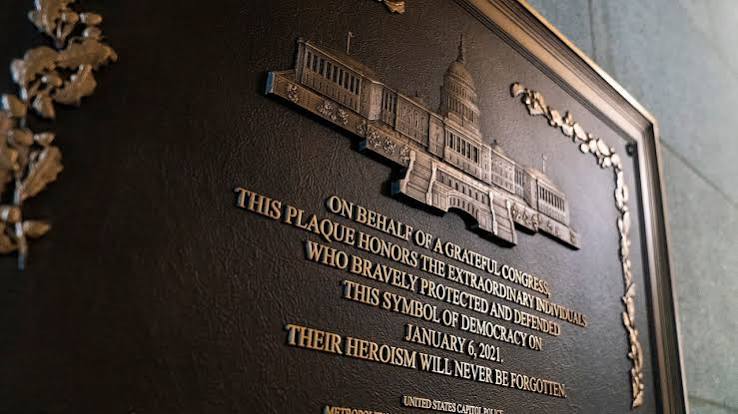
The lawsuit brought by two police officers over a memorial plaque for law-enforcement personnel who responded to the January 6, 2021, attack on the U.S. Capitol has been dismissed by a federal judge. U.S. District Judge Dabney L. Friedrich ruled on September 30, 2026, that former U.S. Capitol Police officer Harry Dunn and Metropolitan Police Department officer Daniel Hodges did not have the legal standing required to bring their claims in federal court.
The ruling is important because it does not decide the separate question of whether the plaque itself fully complies with the 2022 law that ordered it to be created and installed. Instead, the court ended the case because it found that the plaintiffs had not demonstrated a concrete, legally recognizable injury under Article III of the U.S. Constitution.
Latest Update: October 2, 2026
As of October 2, 2026, the federal lawsuit known as Dunn v. Austin, case No. 1:25-cv-01844, has been dismissed at the district-court level. Judge Friedrich granted the Architect of the Capitol’s motion to dismiss for lack of subject-matter jurisdiction based on the plaintiffs’ lack of Article III standing.
The court did not reach the defendants’ alternative arguments concerning whether the plaintiffs had adequately stated their legal claims. As a result, the September 30 decision should not be described as a ruling that the disputed plaque placement was legally correct under every provision of the 2022 law.
Background: Why Is There a Capitol Police Plaque?
The dispute began with Congress’ effort to formally recognize the law-enforcement officers who responded to the January 6 attack on the U.S. Capitol.
Section 214 of the Consolidated Appropriations Act of 2022 expressed Congress’ gratitude to members of the U.S. Capitol Police, the Metropolitan Police Department and other federal, state and local law-enforcement agencies and protective organizations that responded to the violence.
The law directed the Architect of the Capitol to obtain an honorific plaque listing the names of the officers who responded to the violence and to place it at a permanent location on the western front of the U.S. Capitol. The statute gave the Architect one year after enactment to carry out the requirement.
The deadline passed without the memorial being installed in the manner contemplated by the law. That delay eventually became the subject of litigation.
Who Filed the Capitol Police Plaque Lawsuit?
Harry Dunn
Harry Dunn is a former U.S. Capitol Police officer who responded to the January 6 attack. He became one of the most publicly known officers associated with the law-enforcement response and later left the Capitol Police.
Dunn alleged that he experienced physical and psychological consequences from the events of January 6. His lawsuit argued that the government’s failure to properly recognize the responding officers compounded the harm associated with that experience.
Daniel Hodges
Daniel Hodges is a Metropolitan Police Department officer who also responded to the Capitol on January 6. Accounts of the attack describe Hodges as having been involved in a violent confrontation with rioters while officers attempted to defend the building.
Dunn and Hodges jointly filed the federal lawsuit in June 2025 against the Architect of the Capitol and Thomas Austin, the Architect of the Capitol.
The case sought judicial relief related to the government’s failure to install the memorial in the form and location the plaintiffs said Congress had required. Court records show the lawsuit was filed on June 12, 2025.
What Did the 2022 Law Require?
The language of Section 214 is central to understanding why the lawsuit was filed.
Congress directed the Architect of the Capitol to obtain a plaque listing the names of responding officers from the Capitol Police, Metropolitan Police Department and other relevant law-enforcement agencies and protective entities. The law also specified a permanent location on the western front of the Capitol.
The congressional provision did not merely express a general desire for recognition. It included specific instructions concerning the plaque, its contents and its location.
The subsequent dispute focused in part on whether the memorial eventually installed by the Architect satisfied those requirements.
When Was the Plaque Finally Installed?
The plaque was installed in March 2026, more than three years after the statutory deadline had passed. Its installation changed the circumstances of the lawsuit but did not end the dispute between the officers and the Architect of the Capitol.
Reports described the installed plaque as identifying the law-enforcement agencies and organizations involved, with a QR code providing access to the names of individual officers. The plaintiffs argued that this arrangement differed from the statutory requirement that the plaque itself list the names.
The location also became an issue. Reporting in March 2026 described the plaque as being inside the Capitol in an area that was not part of the normal public tour route. The plaintiffs argued that the arrangement did not satisfy the requirement for a permanent location on the western front.
The court itself later considered whether the installation might affect the lawsuit. On March 7, 2026, Judge Friedrich directed the plaintiffs to address whether the case had become moot in light of reports that the plaque had been installed. The plaintiffs maintained that the case should continue because they believed the installation did not satisfy the requirements of the law.
Why Was the Capitol Police Plaque Lawsuit Dismissed?
The central issue in the September 30 ruling was standing.
Standing is a constitutional requirement for federal lawsuits. A person generally must demonstrate a concrete and particularized injury that is actual or imminent, connected to the challenged conduct and capable of being addressed by the requested judicial remedy.
Judge Friedrich concluded that Dunn and Hodges had not shown the kind of legally cognizable injury required under Article III. Their personal connection to the memorial and their interest in how the January 6 officers were recognized did not, by themselves, create the necessary constitutional injury.
The judge also considered the plaintiffs’ arguments concerning psychological or “psychic” injuries associated with the events and the government’s treatment of the memorial. The court concluded that the allegations did not establish the type of concrete injury required for federal jurisdiction.
Because the plaintiffs lacked standing, the court concluded that it lacked subject-matter jurisdiction over their claims. The result was dismissal of the case.
Did the Judge Rule That the Plaque Complies With the Law?
No. This is one of the most important points in the September 30 decision.
The court’s ruling was about whether Dunn and Hodges had standing to bring the lawsuit. It was not a final determination that the plaque’s location, design or method of listing officers necessarily satisfied Section 214 of the 2022 law.
The court therefore did not issue an order requiring the plaque to be moved, redesigned or supplemented with individual names. It also did not issue a finding that every allegation made by the officers about the plaque was incorrect.
Instead, the case ended because the court determined that these particular plaintiffs had not demonstrated the constitutional injury necessary for the federal court to exercise jurisdiction.
What Was the Officers’ Argument?
Dunn and Hodges argued that the government had failed to provide the recognition Congress had required. Their position was that the memorial should honor the individual officers who responded to the attack rather than simply identifying the departments and organizations involved.
They also challenged the plaque’s location. Reports from March 2026 indicated that the memorial had been placed inside the Capitol away from the normal public tour route, while the statute calls for a permanent location on the western front.
The plaintiffs therefore argued that the installation did not end the underlying legal dispute. They wanted the federal court to require compliance with the congressional directive.
Their case also connected the memorial dispute to the personal consequences of January 6. They argued that the lack of individual recognition contributed to the harms they experienced after the attack. The judge ultimately found those allegations insufficient to establish Article III standing.
What Did the Architect of the Capitol Argue?
The Architect of the Capitol challenged the lawsuit on multiple legal grounds.
The defendants argued that Dunn and Hodges lacked standing and therefore could not establish federal jurisdiction. They also raised separate arguments concerning whether the plaintiffs had stated a legally sufficient claim and whether the requested mandamus relief was available against the Architect.
Judge Friedrich resolved the case on the jurisdictional issue. Because the court determined that the plaintiffs lacked standing, it did not need to decide the alternative arguments under Rule 12(b)(6).
Capitol Police Plaque Lawsuit Timeline
| Date | Development |
|---|---|
| January 6, 2021 | Law-enforcement officers from multiple agencies respond to the attack at the U.S. Capitol. |
| March 2022 | Congress passes legislation directing the Architect of the Capitol to obtain and install an honorific plaque. |
| March 2023 | The one-year statutory deadline for installation passes. |
| June 12, 2025 | Harry Dunn and Daniel Hodges file their federal lawsuit. |
| December 2025 | The Architect of the Capitol files a motion to dismiss or, alternatively, for summary judgment. |
| March 2026 | The plaque is installed, prompting further dispute over its location and contents. |
| September 30, 2026 | Judge Dabney L. Friedrich dismisses the lawsuit for lack of Article III standing. |
| October 2, 2026 | The district-court dismissal remains the latest major development in the case. |
Quick Facts About the Lawsuit
| Detail | Information |
|---|---|
| Case | Dunn et al. v. Austin et al. |
| Case Number | No. 1:25-cv-01844 (DLF) |
| Court | U.S. District Court for the District of Columbia |
| Judge | Dabney L. Friedrich |
| Plaintiffs | Harry Dunn and Daniel Hodges |
| Defendants | Thomas Austin and the Architect of the Capitol |
| Lawsuit Filed | June 12, 2025 |
| Main Issue | Installation and placement of the January 6 law-enforcement memorial plaque |
| Dismissal Date | September 30, 2026 |
| Reason for Dismissal | Lack of Article III standing and subject-matter jurisdiction |
What Does the Dismissal Mean?
The immediate effect is that Dunn and Hodges’ particular federal lawsuit has been dismissed at the district-court level.
The decision does not automatically settle every broader question about the plaque. The underlying congressional language remains part of the public record, and the September 30 ruling did not provide a merits determination that the current plaque arrangement satisfies every requirement of Section 214.
The ruling also illustrates the difference between believing that a government action violates a law and having the constitutional standing necessary to ask a federal court to intervene. Federal courts cannot decide every dispute simply because a plaintiff has a strong personal or civic interest in the subject.
Could the Lawsuit Be Appealed?
A district-court dismissal can generally be reviewed by a federal appellate court if the parties pursue an appeal within the applicable deadline. Whether Dunn and Hodges will appeal, and what legal arguments they might raise, would be a separate development from the September 30 dismissal.
As of October 2, 2026, the confirmed development is the district court’s dismissal for lack of standing. No later appellate ruling should be treated as established unless and until one is entered.
Why the Plaque Dispute Remains Significant
The controversy has continued because it involves both a specific congressional directive and the way the government publicly recognizes the law-enforcement response to January 6.
The 2022 statute specifically called for a plaque listing the names of responding officers and identified the western front as the permanent location. The eventual installation generated a separate disagreement over whether listing agencies alongside a QR code and placing the plaque inside the building fulfilled those instructions.
Those questions were not resolved on their merits by the September 30 dismissal. The court’s decision was limited to the plaintiffs’ standing and the resulting jurisdictional problem.
Reader Questions
Why was the Capitol Police plaque lawsuit dismissed?
Judge Dabney L. Friedrich dismissed the case because Harry Dunn and Daniel Hodges did not establish Article III standing. The court therefore concluded that it lacked subject-matter jurisdiction to hear their claims.
Who sued over the Capitol Police plaque?
Former U.S. Capitol Police officer Harry Dunn and Metropolitan Police Department officer Daniel Hodges filed the lawsuit in June 2025. They sought judicial relief concerning the installation and placement of the memorial required by Congress.
What did Congress require for the January 6 plaque?
Section 214 of the 2022 appropriations law directed the Architect of the Capitol to obtain an honorific plaque listing the names of responding officers. It also directed that the plaque be placed at a permanent location on the western front of the U.S. Capitol.
Was the Capitol plaque eventually installed?
Yes. The plaque was installed in March 2026, but its placement and the way individual officers’ names were presented became part of the continuing dispute.
Did the judge say the plaque placement was legal?
No. The September 30 ruling focused on standing and subject-matter jurisdiction. It did not resolve the underlying statutory-compliance questions on the merits.
What is Article III standing?
Article III standing is a constitutional requirement for federal lawsuits. Generally, a plaintiff must demonstrate a concrete and particularized injury that is connected to the challenged conduct and can be addressed through the requested judicial relief.
Does the dismissal mean the officers’ allegations were proven false?
No. The dismissal was jurisdictional rather than a merits ruling on every factual and legal dispute surrounding the plaque. The court determined that the plaintiffs had not shown the type of injury required to bring the case in federal court.
What happens to the Capitol plaque now?
The September 30 decision did not order officials to move, redesign or replace the plaque. Any future change could come through administrative action, congressional action or separate litigation, but no such later development should be treated as confirmed without supporting records.
Wrap-Up
The Capitol Police plaque lawsuit ended with a ruling focused on a constitutional requirement that can be easy to overlook: standing. Judge Dabney L. Friedrich did not decide whether the current memorial arrangement fully satisfies Congress’ 2022 directive. Instead, she concluded that Harry Dunn and Daniel Hodges had not demonstrated the legally recognizable injury required for a federal court to hear their claims.
The distinction matters because the lawsuit grew out of a very specific congressional instruction. Congress directed the Architect of the Capitol to create an honorific plaque listing responding officers and to place it at a permanent location on the Capitol’s western front. The plaque was eventually installed in 2026, but its contents and location remained disputed.
For now, the clearest description of the September 30 development is that the federal district court dismissed Dunn v. Austin for lack of Article III standing. The ruling ended the plaintiffs’ case at that level without providing a final merits ruling on whether the disputed plaque arrangement complied with every requirement of the 2022 law.
Disclaimer
This article is provided for informational purposes and summarizes publicly reported court and legislative information available as of October 2, 2026. Legal proceedings can change through appeals, new court orders, congressional action or administrative decisions. Readers should consult the underlying court record and qualified legal professionals for legal advice.
